Print on demand (POD) has fundamentally changed how entrepreneurs and creators sell custom-designed physical products
online. Instead of investing thousands of dollars in upfront inventory, managing warehouse space, and handling
shipping logistics, print on demand allows sellers to create custom designs for products—t-shirts, hoodies, mugs,
phone cases, posters, and dozens of other items—that are manufactured and shipped only after a customer places an
order. This zero-inventory model eliminates the financial risk traditionally associated with product-based
businesses and makes it possible for anyone with design ideas to launch a product line.
Printful is one of the leading print on demand and dropshipping fulfillment companies, serving over 350,000 online
sellers worldwide. Founded in 2013 by Lauris Liberts in Charlotte, North Carolina, the company operates multiple
fulfillment centers across North America, Europe, and Asia, enabling localized production that reduces shipping
times and costs for customers in different regions. Printful integrates directly with major e-commerce platforms
including Shopify, WooCommerce, Etsy, Amazon, eBay, Squarespace, Wix, and BigCommerce, allowing sellers to connect
their online stores and automate the entire order fulfillment process.
This guide provides a comprehensive overview of how Printful works, its product catalog, integration capabilities,
pricing structure, quality considerations, strengths, and limitations. The goal is to present detailed, factual
information that helps you evaluate whether Printful is the right print on demand partner for your online business.
I. How Printful Works
The Print on Demand Process
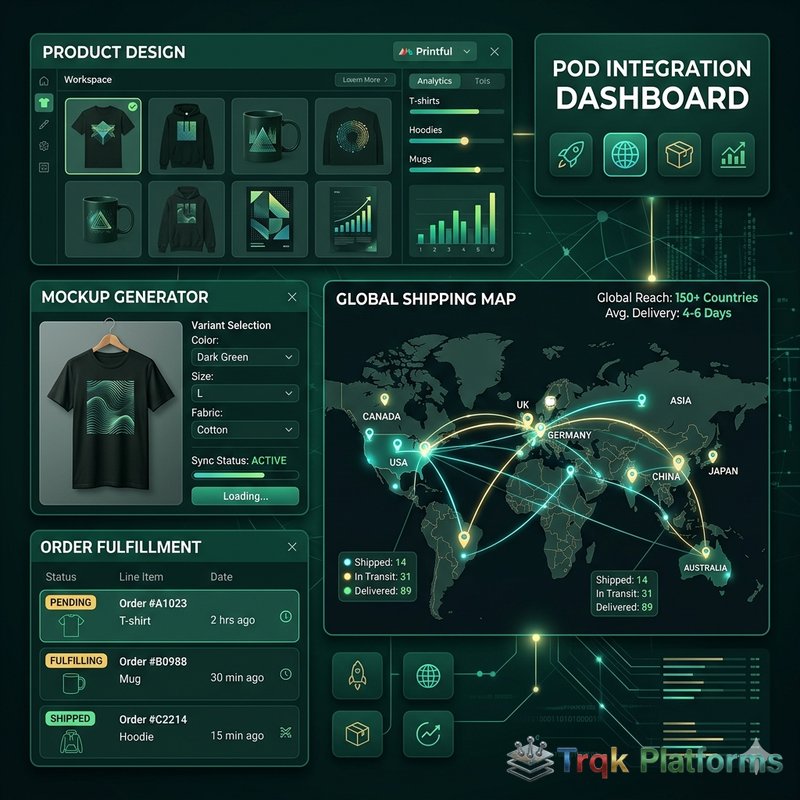
Printful’s business model operates on a straightforward workflow: the seller creates product designs, lists products
on their online store, and when a customer places an order, the order is automatically sent to Printful for
production and fulfillment. The detailed process flows as follows: the seller designs products using Printful’s
mockup generator, uploads designs, sets retail prices, and publishes products to their connected store. When a
customer purchases a product, the order is automatically synced from the store to Printful. Printful prints or
embroiders the design onto the product at one of its fulfillment centers, packages the item with the seller’s custom
branding (if configured), and ships it directly to the customer with a tracking number. The seller pays Printful’s
base production cost plus shipping, and keeps the difference between the retail price and these costs as profit.
No Upfront Costs or Minimum Orders
One of Printful’s most significant advantages is the complete elimination of upfront inventory investment. There are
no minimum order requirements, no monthly subscription fees for the basic service, and no costs until an actual
customer order is placed. This model allows entrepreneurs to test product ideas with zero financial risk—if a design
does not sell, the seller loses nothing because no products were manufactured in advance. This is fundamentally
different from traditional manufacturing where unsold inventory represents a direct financial loss.
II. Product Catalog
Available Product Categories
Printful offers an extensive catalog of customizable products spanning multiple categories:
| Category | Products | Customization |
|---|---|---|
| Apparel | T-shirts, hoodies, tank tops, leggings, dresses, shorts |
DTG printing, all-over print, embroidery |
| Accessories | Phone cases, tote bags, backpacks, fanny packs, socks | Sublimation, DTG printing |
| Home & Living | Mugs, pillows, blankets, towels, bean bags, aprons | Sublimation, DTG printing |
| Wall Art | Posters, canvas prints, framed prints, metal prints | High-quality digital printing |
| Stationery | Notebooks, stickers, greeting cards, postcards | Digital printing |
| Hats | Dad hats, snapbacks, beanies, bucket hats, visors | Embroidery, patches, DTG printing |
Product Quality and Printing Methods
Printful uses several printing technologies depending on the product type and customization requirements.
Direct-to-Garment (DTG) printing applies ink directly onto fabric using industrial inkjet technology, producing
detailed, vibrant designs with excellent color accuracy. DTG works best on cotton and cotton-blend fabrics.
Sublimation printing uses heat to transfer dye into the fabric, enabling all-over printing that covers the entire
surface of a product. Embroidery uses threaded stitching for a premium, textured finish that is particularly popular
for hats, polo shirts, and corporate apparel. Cut and sew manufacturing creates products from scratch using
custom-printed fabric panels, allowing for fully customized designs including unique sizing, labels, and
construction details.
Product quality varies by product category and blank product brand. Printful sources blank products from established
brands including Bella+Canvas, Gildan, District, and Champion for apparel, and uses proprietary manufacturing for
many home and accessory items. The company maintains quality control processes at each fulfillment center and
provides sample ordering at discounted prices so sellers can evaluate product quality before listing items in their
stores.
III. E-commerce Platform Integrations
Supported Platforms
Printful integrates with a wide range of e-commerce platforms, marketplaces, and website builders. Key integrations
include Shopify (native app with automatic order sync), WooCommerce (WordPress plugin with seamless integration),
Etsy (direct marketplace integration), Amazon (fulfilled by Printful with Amazon product listings), eBay (automated
order processing), Squarespace (native extension), Wix (integrated app), BigCommerce (native channel app), and Ecwid
(embedded store integration). Each integration enables automatic order forwarding from the store to Printful,
product sync for maintaining consistent inventory and pricing, and tracking number delivery back to the store for
customer notifications.
Printful API
For businesses with custom e-commerce setups or unique workflow requirements, Printful provides a REST API that
enables direct integration with any platform or application. The API supports product catalog access, order creation
and management, shipping rate calculation, mockup generation, and webhook notifications for order status updates.
This API access enables developers to build custom storefronts, create personalized product configurators, or
integrate Printful into existing business systems that are not covered by pre-built integrations.
IV. Pricing and Profit Margins
Cost Structure
Printful’s pricing model is transparent: sellers pay a base cost per product that covers manufacturing, materials,
and Printful’s margin. The seller then sets the retail price charged to customers, and the difference between the
retail price and the base cost (minus shipping) represents the seller’s profit. There are no monthly subscription
fees, setup costs, or minimum order requirements for the basic service. Printful Growth is a premium subscription
tier that offers reduced product prices, access to custom branding features, and additional design tools for a
monthly fee, which can improve margins for sellers with consistent order volume.
Shipping costs are calculated based on the destination, product weight, and shipping method selected. Printful
provides flat-rate shipping for many product categories and offers shipping rate calculators that integrate with
connected stores. The company also offers Printful Shipping, which combines items in a single order into one
shipment when possible, reducing per-item shipping costs for multi-item orders.
Profit Margin Considerations
Print on demand profit margins are generally lower than traditional wholesale or manufacturing models because of the
per-unit production costs inherent in on-demand manufacturing. Typical margins range from 20% to 40% depending on
the product category, retail pricing strategy, and whether the seller uses Printful Growth for reduced base costs.
Apparel typically offers margins of 25-40%, while accessories and home items may provide margins of 30-50% due to
higher perceived value relative to production costs. Sellers need to balance competitive pricing with sufficient
margins to cover marketing costs, platform fees, and business expenses.
V. Design Tools and Mockup Generator
Design Maker
Printful includes a free Design Maker tool that allows sellers to create product designs directly within the Printful
dashboard without external design software. The tool provides text tools with hundreds of fonts, clipart libraries,
the ability to upload custom images and graphics, layer management for combining multiple design elements, and
preview capabilities that show how designs will appear on the actual products. While the Design Maker is suitable
for basic designs and text-based products, sellers creating complex or detailed artwork typically use professional
design software like Adobe Photoshop, Illustrator, or Canva and upload finished design files to Printful.
Mockup Generator
The Mockup Generator creates professional product images showing designs on realistic product mockups. These mockup
images are essential for online listings because customers need to see how products look before purchasing. Printful
generates mockups automatically for each product variant (different colors, sizes, and angles), producing images
that can be used directly in e-commerce store listings. The generator creates multiple mockup styles including flat
lay views, lifestyle images, and close-up detail shots that help customers visualize the final product.
Shipping Methods and Delivery Times
Printful offers multiple shipping methods for different markets and delivery speed requirements. Standard shipping within the United States typically takes 5-12 business days including production time (2-5 business days for production plus 3-7 business days for shipping). Express shipping options reduce delivery time to 3-7 business days total for eligible products. International shipping times vary by destination but typically range from 8-20 business days for standard delivery. Printful’s multiple fulfillment center strategy means that orders are produced at the facility closest to the customer’s shipping address when possible, reducing both shipping costs and delivery times. For European customers, orders are typically produced at European fulfillment locations, avoiding international shipping delays and customs processing from other continents. Similarly, orders shipped within the United States are produced at US-based facilities for optimal domestic delivery times.
VI. Custom Branding Features
White-Label Fulfillment
Printful supports white-label fulfillment, meaning products are shipped with the seller’s branding rather than
Printful’s. Custom branding options include inside labels (woven or printed labels with the seller’s logo replacing
Printful’s branding), pack-ins (custom inserts like thank you cards, promotional materials, and return
instructions), custom packaging (branded poly mailers and tissue paper), and packing slips with the seller’s logo,
store name, and contact information. These branding features help sellers create a professional, branded unboxing
experience that builds customer loyalty and brand recognition, making the print on demand nature of the business
invisible to end customers.
Warehousing and Inventory Storage
While Printful is primarily known as a print on demand platform, it also offers warehousing and fulfillment services for products that are not printed on demand. Sellers who have pre-manufactured products-such as items sourced from manufacturers, pre-printed inventory from large batch orders, or non-customizable accessories-can store them in Printful’s fulfillment centers and have Printful handle picking, packing, and shipping when orders come in. This hybrid approach allows sellers to combine print on demand products with pre-manufactured inventory within the same store, using Printful as a unified fulfillment partner for all product types. Warehousing fees include receiving fees, storage fees based on cubic feet per month, and pick-and-pack fees per order, making it a viable option for sellers who want to consolidate their fulfillment operations.
Sustainability and Ethical Practices
Printful has increasingly focused on sustainability initiatives within its operations. The company has implemented eco-friendly packaging options, reduced waste through on-demand production (which eliminates overproduction and unsold inventory waste that plagues traditional manufacturing), and expanded its catalog to include organic and sustainably sourced blank products. Printful’s localized production model-manufacturing products at the fulfillment center closest to the customer-reduces shipping distances and associated carbon emissions compared to centralized manufacturing and global shipping. The company also offers water-based DTG inks that are OEKO-TEX certified, meaning they have been tested and verified to be free from harmful chemicals. For environmentally conscious sellers, these practices can be part of a broader brand story about responsible production and consumption.
Printful Growth Subscription
Printful Growth is a premium subscription service designed for sellers with consistent order volume who want to maximize their margins and access advanced features. The subscription provides reduced product prices (up to 30% lower than standard pricing on some items), which directly improves profit margins on every order. Additional benefits include access to custom branding features such as inside labels, pack-ins, and branded packaging, priority support with faster response times, and exclusive product access. The subscription is priced on a monthly basis with the cost offset by savings on product prices-Printful provides a calculator that estimates savings based on projected order volume to help sellers determine whether the subscription makes financial sense for their business.
Quality Assurance and Returns
Printful implements quality checks at each fulfillment center before products are shipped, including visual inspection of print quality, color accuracy, and product integrity. Despite these quality measures, defects can occasionally occur with any manufacturing process. Printful handles defective product returns and reprints at no cost to the seller when the defect is a result of printing or manufacturing errors. Sellers can set up return and exchange policies through their connected e-commerce platforms, and Printful provides guidelines for handling customer complaints related to sizing, design placement, and product quality. The company’s sample ordering feature, which provides products at a discounted rate, allows sellers to personally evaluate quality before listing products for sale and to create authentic product photography for their store listings.
For sellers looking to build a recognizable brand around their products, the ability to present orders under their own brand identity rather than Printful’s is a critical differentiator that transforms print on demand from a generic fulfillment service into a true brand-building partner.
VII. Strengths and Limitations
Strengths
- Zero upfront investment with no minimum order requirements
- Extensive product catalog with diverse customization options
- Multiple printing methods including DTG, embroidery, and sublimation
- Global fulfillment centers for faster regional shipping
- Integrations with all major e-commerce platforms and marketplaces
- White-label branding creates a professional customer experience
- Free design tools and mockup generator included
- Sample discounts allow quality verification before selling
- API access for custom integrations
Limitations
- Lower profit margins compared to bulk manufacturing
- Per-unit costs are higher than wholesale purchasing
- Production time adds 2-5 days before shipping begins
- Limited control over production quality for individual orders
- Shipping costs can be significant, especially for international orders
- Product selection, while extensive, does not cover all physical product types
- Peak season delays possible during high-demand periods
- Custom branding features require Printful Growth subscription
VIII. Alternatives to Consider
The print on demand market includes several alternatives worth evaluating. Printify offers a marketplace model
connecting sellers with multiple print providers, often providing lower base prices through competition between
providers but with potentially less consistent quality. Gooten operates similarly to Printify with a network of
manufacturing partners. Gelato focuses on localized printing with production partners in 32+ countries, emphasizing
reduced shipping distances and carbon emissions. Spring (formerly Teespring) offers a free storefront platform
specifically for creators and influencers. SPOD (by Spreadshirt) emphasizes fast production times with most orders
shipped within 48 hours. Redbubble and Society6 provide their own marketplace platforms where artists can upload
designs and earn royalties without managing their own stores. The right choice depends on product selection needs,
geographic market focus, integration requirements, and whether you prefer managing your own store or selling through
a marketplace.
IX. Conclusion
Printful has established itself as one of the most reliable and comprehensive print on demand platforms available,
offering a combination of product variety, quality printing methods, global fulfillment, and seamless e-commerce
integrations that makes it suitable for both new entrepreneurs testing product ideas and established brands
expanding their merchandise offerings. The zero-upfront-cost model removes traditional barriers to launching a
product-based business, while the integration with major e-commerce platforms enables automated fulfillment that
scales without proportional increases in operational complexity.
The platform works best for sellers who value quality and brand consistency, are willing to accept somewhat lower
margins in exchange for zero inventory risk, and want reliable fulfillment with reasonable production times. For
creators, designers, and entrepreneurs evaluating print on demand services, Printful’s sample ordering program
provides a practical way to assess product quality firsthand before committing to listing products in your store.
About The Publisher

TRQK Platforms Editor
The TRQK Editorial Team meticulously investigates and evaluates the world's most powerful digital platforms. Our mission is to provide transparent, in-depth reviews that empower businesses to scale with the right technology.