Dropshipping has emerged as one of the lowest-barrier entry points into e-commerce, allowing entrepreneurs to sell
products online without holding inventory, managing warehouse space, or handling shipping logistics. In the
dropshipping model, the store owner lists products from suppliers on their online store, and when a customer places
an order, the supplier ships the product directly to the customer. The store owner earns the difference between the
retail price and the supplier’s wholesale cost without ever physically handling the merchandise.
Oberlo was one of the most popular dropshipping platforms, specifically designed to work with Shopify to connect
store owners with suppliers—primarily through AliExpress, the global wholesale marketplace operated by Alibaba
Group. Oberlo simplified the process of finding products, importing them into Shopify stores with complete product
descriptions and images, and automating order fulfillment by forwarding customer orders to suppliers. At its peak,
Oberlo powered hundreds of thousands of Shopify dropshipping stores and facilitated the sale of millions of products
worldwide.
In June 2022, Shopify officially discontinued the Oberlo app and migrated its core functionality into DSers, the
recommended replacement app. However, Oberlo’s impact on the dropshipping ecosystem was profound, and its approach
to product sourcing and order automation established patterns that continue to influence how modern dropshipping
tools operate. This article provides a comprehensive examination of the Oberlo model, the dropshipping workflow it
popularized, current alternatives and successors, and important considerations for anyone evaluating dropshipping as
a business model.
I. How Oberlo Worked
The Dropshipping Workflow
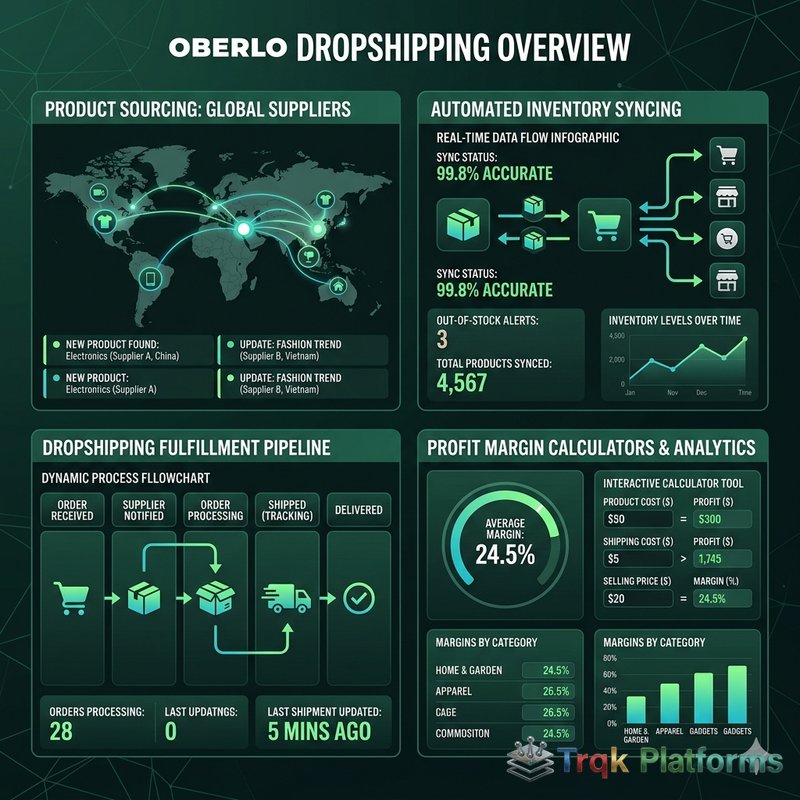
Oberlo’s core functionality centered on a streamlined workflow that connected AliExpress suppliers with Shopify store
owners. The process began with product discovery: store owners browsed AliExpress through Oberlo’s interface,
filtering products by category, shipping method, ratings, and order volume. When a suitable product was found, it
could be imported to the Shopify store with a single click, bringing along product images, descriptions, variants
(size, color, etc.), and supplier pricing information. The store owner could then customize the imported product
listing—editing titles, descriptions, images, and most importantly, setting retail prices that included their
desired profit margin above the supplier’s wholesale cost.
When a customer purchased a product from the Shopify store, the order appeared in Oberlo’s dashboard. The store owner
(or Oberlo’s automation) would then place the corresponding order with the AliExpress supplier, entering the
customer’s shipping address as the delivery destination. The supplier would ship the product directly to the
customer, and tracking information could be synced back to the Shopify store for customer notification. This
end-to-end process—from product discovery through order fulfillment—could be managed entirely from the Oberlo
dashboard without the store owner ever touching or seeing the physical product.
Key Features
| Feature | Description |
|---|---|
| One-Click Import | Import products from AliExpress directly to Shopify with full details |
| Automated Pricing | Set markup rules to automatically calculate retail prices |
| Inventory Sync | Automatic stock updates from suppliers to prevent overselling |
| Order Automation | Forward orders to suppliers with customer shipping details |
| Tracking Sync | Import shipping tracking numbers back to Shopify orders |
| Multiple Suppliers | Source same product from different suppliers for backup |
| ePacket Filtering | Filter for ePacket shipping for faster delivery from China |
II. The Transition to DSers
Why Shopify Discontinued Oberlo
Shopify acquired Oberlo in 2017 and operated it as a first-party dropshipping solution. In 2022, Shopify decided to
discontinue Oberlo and recommended DSers as the official replacement app for AliExpress dropshipping. The transition
was driven by DSers’ more advanced feature set, including support for bulk order processing (placing hundreds of
supplier orders simultaneously rather than one at a time), supplier optimization tools that automatically identify
better-priced or faster-shipping suppliers for existing products, mapping features for linking product variants to
different suppliers, and multi-store management capabilities. All Oberlo users were migrated to DSers, and the
Oberlo app was permanently removed from the Shopify App Store.
DSers as Oberlo’s Successor
DSers continues the core Oberlo model while adding capabilities that address many of Oberlo’s limitations. DSers
supports bulk ordering (processing multiple AliExpress orders simultaneously rather than individually), automatic
supplier tracking number update synchronization, product mapping from multiple suppliers for redundancy, bundle
product creation combining items from different suppliers into a single listing, and integration with not only
Shopify but also WooCommerce and Wix. For store owners who previously used Oberlo, DSers provides a familiar
workflow with enhanced efficiency and multi-platform support.
III. Understanding the Dropshipping Business Model
Advantages of Dropshipping
The dropshipping model offers several structural advantages that make it attractive for new entrepreneurs. The most
significant is the elimination of upfront inventory investment—there is no need to purchase products before they are
sold, so financial risk is minimal. Operating costs are low because there is no warehouse, no shipping
infrastructure, and no need for fulfillment staff. Product testing is fast and inexpensive—if a product does not
sell, it can be removed from the store without financial loss. Location independence allows the business to be
operated from anywhere with an internet connection. Scalability is relatively straightforward because increased
order volume does not require proportional increases in infrastructure or staff—the supplier handles production and
shipping regardless of volume.
Challenges and Limitations
Despite its accessibility, dropshipping presents genuine challenges that prospective entrepreneurs should understand
clearly. Profit margins are typically thin—products sourced from AliExpress and similar platforms are available to
anyone, creating intense price competition that compresses margins. A common margin range is 15-40%, but after
advertising costs (which are often the largest expense), net profits can be significantly lower. Shipping times from
Chinese suppliers to Western markets can range from 2-6 weeks for standard shipping, creating customer satisfaction
issues in an era when consumers expect delivery within days. Product quality is variable and outside the store
owner’s direct control, which can lead to customer complaints, returns, and negative reviews. Returns and refunds
are complicated because products must be returned to the overseas supplier or written off entirely—most dropshippers
absorb return costs rather than managing international return shipping.
Brand building is difficult when selling generic products available from multiple other dropshipping stores. There is
no ability to inspect products, control packaging, or include branded inserts (though some suppliers offer these
services for additional fees). Customer service responsibility falls entirely on the store owner despite having no
control over product quality, shipping speed, or fulfillment accuracy. These challenges do not make dropshipping
unviable, but they mean that success requires careful product selection, effective marketing, managing customer
expectations about shipping times, and ongoing optimization of supplier relationships and advertising campaigns.
IV. Product Selection Strategies
Criteria for Product Selection
Successful dropshipping operations typically share common product selection strategies. Products with strong visual
appeal tend to perform well in social media advertising—the primary customer acquisition channel for many
dropshipping stores. Products that solve a specific problem or serve a niche audience face less competition than
generic consumer goods. Items with perceived high value but moderate actual cost provide sufficient margin for
advertising expenses. Products that are lightweight and compact result in lower shipping costs and fewer shipping
damage issues. Avoiding products with sizing complications (like clothing) reduces return rates for stores that
cannot offer exchanges. Products with long sales cycles (evergreen products) provide more stable revenue than
trending items that may lose popularity quickly.
Supplier Evaluation
Selecting reliable suppliers is critical for dropshipping success. Key evaluation criteria include supplier ratings
and review scores on AliExpress or alternative platforms, order volume history (indicating experience with
international fulfillment), available shipping methods and estimated delivery times to target markets, communication
responsiveness (testing supplier communication before committing), product quality verification through ordering
samples, and willingness to customize packaging or include branded materials. Establishing relationships with
reliable suppliers and maintaining backup suppliers for key products protects against supplier stockouts, quality
declines, or sudden price increases that can disrupt business operations.
V. Marketing for Dropshipping Stores
Customer Acquisition Channels
Most dropshipping stores rely heavily on paid advertising for customer acquisition, with Facebook and Instagram ads
being the most common channels due to their visual format and detailed demographic targeting options. TikTok
advertising has become increasingly popular for product-focused video ads targeting younger demographics. Google
Shopping ads capture purchase-intent traffic from people actively searching for specific products. Influencer
marketing through Instagram and TikTok provides product exposure to engaged audiences. Content marketing and SEO can
drive long-term organic traffic but requires consistent investment in content creation. Email marketing to previous
customers and subscribers provides a cost-effective channel for repeat purchases and new product launches.
Advertising cost management is often the determining factor in dropshipping profitability. With thin product margins,
the cost per acquisition must be kept below the profit per order for the business to remain viable. This requires
ongoing ad testing, audience refinement, and conversion rate optimization to maintain profitable advertising
campaigns over time.
Store Optimization and Conversion
Beyond product selection and advertising, dropshipping store optimization significantly impacts profitability. Key optimization areas include store design and trust signals (professional templates, clear contact information, customer reviews, secure checkout badges, and transparent shipping policies that build buyer confidence), product page optimization (high-quality images, detailed descriptions, size charts, customer reviews and photos, and clear shipping time estimates), checkout optimization (minimizing checkout steps, offering multiple payment methods, providing guest checkout, and displaying security badges), and email marketing automation (welcome sequences, abandoned cart recovery, post-purchase follow-ups, and re-engagement campaigns for inactive customers). Each of these optimization areas contributes to higher conversion rates, which directly improves the return on advertising investment and overall business profitability.
VI. Current Alternatives to Oberlo
| Platform | Key Differentiator | Supported Stores |
|---|---|---|
| DSers | Official Oberlo successor, bulk ordering | Shopify, WooCommerce, Wix |
| Spocket | US/EU suppliers for faster shipping | Shopify, WooCommerce, Wix, BigCommerce |
| CJ Dropshipping | US warehousing, custom packaging | Shopify, WooCommerce, eBay |
| Zendrop | Fast US shipping, branded invoicing | Shopify, WooCommerce |
| Modalyst | Independent brands and trending products | Shopify, Wix, BigCommerce |
The evolution from Oberlo to more advanced dropshipping tools like DSers, Spocket, and CJ Dropshipping reflects the broader maturation of the dropshipping industry. Modern tools now address many of Oberlo’s original limitations, particularly around shipping speed, product quality verification, and brand customization options that were not available in the early days of automated dropshipping.
VII. Strengths and Limitations of Dropshipping
Strengths
- Zero inventory investment eliminates upfront financial risk
- Low startup costs (store subscription + marketing budget only)
- Location-independent business operation
- Easy product testing without financial commitment
- Scalable without proportional infrastructure investment
- Wide product selection through global supplier networks
- No warehousing, packaging, or shipping management required
Limitations
- Thin profit margins due to intense competition
- Long shipping times from overseas suppliers
- Limited quality control over supplier products
- Difficult to build long-term brand equity with generic products
- Customer service challenges when fulfillment is outsourced
- Dependency on supplier reliability and stock availability
- Advertising costs can quickly erode margins
- High competition for trending products across multiple stores
Legal and Tax Considerations
Dropshipping businesses face specific legal and tax considerations that vary by jurisdiction. In most countries, dropshipping is a legitimate business model, but store owners are responsible for accurately representing products, handling consumer protection obligations, collecting and remitting applicable sales taxes, complying with import regulations for products shipped from overseas, and adhering to advertising standards in their marketing materials. In the United States, the Federal Trade Commission requires that online sellers disclose expected delivery times and provide options for cancellation if delivery will be significantly delayed. European Union regulations mandate clear information about the seller, return policies, and the right of withdrawal. Store owners should consult with local business advisors or legal professionals regarding business registration requirements, tax obligations, and consumer protection compliance specific to their jurisdiction and target markets.
Building a Sustainable Dropshipping Business
While the initial attraction of dropshipping is its low barrier to entry, building a sustainable, profitable dropshipping business requires strategic thinking beyond simply listing products and running ads. Successful dropshippers often evolve their businesses over time in several ways. Niche specialization involves focusing on a specific product category or customer segment rather than selling everything to everyone, which enables more targeted marketing and builds category expertise. Custom branding involves working with suppliers who offer custom packaging, branded inserts, and private labeling to differentiate products from generic alternatives available on competing stores. Product quality curation means regularly ordering and testing products to ensure consistent quality, and quickly removing products that generate complaints or negative reviews.
Supplier relationship building involves establishing direct relationships with manufacturers or established suppliers rather than relying solely on marketplace-found suppliers, which can lead to better pricing, faster shipping options, and priority treatment during high-demand periods. Customer experience investment means implementing professional customer service processes, realistic delivery estimates, order tracking systems, and easy return policies that build customer trust and encourage repeat purchases. Transitioning to hybrid models represents the evolution beyond pure dropshipping by incorporating inventory-based fulfillment for best-selling products, using print-on-demand for customized items, or working with domestic fulfillment centers that stock popular products for faster delivery times. These strategies progressively improve margins, customer satisfaction, and business defensibility over time.
Financial Planning for Dropshipping
Understanding the financial structure of a dropshipping business is essential for evaluating viability and setting realistic expectations. The typical cost structure includes the product cost paid to the supplier, marketing and advertising expenses (often 30-50% of revenue for new stores), platform subscription fees (Shopify, WooCommerce hosting, etc.), payment processing fees (typically 2.9% plus a fixed per-transaction fee), dropshipping app subscriptions (DSers, Spocket, etc.), domain and email costs, and returns and refund costs. After accounting for all these expenses, net profit margins for dropshipping businesses typically range from 10-30% of revenue for well-optimized stores. New stores often operate at a loss during the initial testing and optimization phase while identifying profitable products and advertising strategies, before achieving profitability as customer acquisition costs decrease through improved targeting and organic traffic growth.
For aspiring e-commerce entrepreneurs evaluating the dropshipping model, it is important to approach the opportunity with a clear understanding of both the advantages and the challenges. The most successful dropshipping businesses are those that treat it as a real business requiring consistent effort, strategic thinking, and patient optimization rather than a passive income shortcut that requires minimal involvement.
VIII. Conclusion
Oberlo pioneered the accessible, automated dropshipping model that lowered the barrier to e-commerce entrepreneurship
for hundreds of thousands of store owners worldwide. While the Oberlo app itself has been discontinued, its legacy
continues through DSers and the many dropshipping tools that followed its product-import-and-fulfill model. The
dropshipping business model remains viable for entrepreneurs who approach it with realistic expectations about
margins, shipping times, and the competitive landscape.
For those considering dropshipping, the key to sustainable success lies not in the tools themselves but in the
fundamentals: identifying products that serve genuine customer needs, building effective marketing that drives
profitable customer acquisition, managing customer expectations about delivery times, maintaining quality supplier
relationships, and gradually building a brand that differentiates your store from the thousands of others selling
similar products. The tools have evolved since Oberlo’s era, with modern platforms offering faster shipping options
through domestic warehousing, better supplier vetting, and more sophisticated automation—but the core challenge of
building a profitable, customer-focused dropshipping business remains the same, regardless of which specific app or platform is powering the backend automation.
About The Publisher

TRQK Platforms Editor
The TRQK Editorial Team meticulously investigates and evaluates the world's most powerful digital platforms. Our mission is to provide transparent, in-depth reviews that empower businesses to scale with the right technology.