E-commerce Platforms, Customer Engagement, Klaviyo, Customer Segmentation
Customer engagement remains one of the highest-return marketing channels for e-commerce businesses, consistently
delivering stronger ROI than social media advertising, display ads, and most other digital marketing channels.
However, the effectiveness of ecommerce communication depends heavily on the platform’s ability to leverage customer data
for personalized, timely, and relevant communications. Generic email blasts to undifferentiated subscriber lists
generate diminishing returns as consumers increasingly expect personalized experiences tailored to their interests
and purchase behavior.
Klaviyo is an customer data and marketing platform built specifically for e-commerce businesses. Unlike general-purpose
ecommerce communication tools like Mailchimp or Constant Contact that serve all types of businesses, Klaviyo focuses
exclusively on the e-commerce space, with deep integrations into e-commerce platforms (particularly Shopify),
advanced customer segmentation based on purchase behavior and browsing activity, and automated email flows triggered
by specific customer actions. Founded in 2012 by Andrew Bialecki and Ed Hallen, Klaviyo went public in September
2023 and serves over 143,000 customers worldwideâÂÂfrom small Shopify stores to major brands like Glossier, Chubbies,
and Living Proof.
This article provides a comprehensive examination of Klaviyo’s features, segmentation capabilities, automation
workflows, SMS marketing tools, analytics, pricing, and overall suitability for e-commerce businesses. The goal is
to present detailed, objective information that helps you evaluate whether Klaviyo’s customer-centric approach to
e-commerce marketing aligns with your business needs.
I. E-commerce Data Integration
Deep Platform Integrations
Klaviyo’s core advantage is its deep integration with e-commerce platforms that enables real-time synchronization of
customer data, order history, product catalog information, and browsing behavior. The Shopify integrationâÂÂKlaviyo’s
strongest partnershipâÂÂprovides automatic syncing of customer profiles with complete purchase history, real-time cart
and checkout event tracking, product catalog synchronization for personalized product recommendations, customer
lifetime value calculations, and predictive analytics based on historical purchase data. Similar integrations exist
for WooCommerce, BigCommerce, Magento, Salesforce Commerce Cloud, and other e-commerce platforms, though the Shopify
integration remains the most feature-rich.
Customer Data Platform
Klaviyo functions as both an ecommerce communication platform and a lightweight Customer Data Platform (CDP), aggregating
data from multiple sources into unified customer profiles. Each customer profile contains transaction history with
complete order details and revenue attribution, website browsing activity including product views, cart additions,
and checkout behavior, email engagement metrics including opens, clicks, and conversion history, SMS engagement
data, custom properties and events tracked through Klaviyo’s API, and predictive analytics including expected date
of next order, predicted customer lifetime value, and churn risk score. This comprehensive customer view enables
segmentation and personalization that goes far beyond basic demographic targeting.
II. Segmentation and Targeting
Advanced Segmentation Engine
Klaviyo’s segmentation capabilities are among the most sophisticated in the e-commerce communication space.
Segments are dynamicâÂÂthey update automatically in real-time as customer behavior changesâÂÂand can be built using any
combination of hundreds of data points:
| Segment Type | Example Conditions |
|---|---|
| Purchase Behavior | Bought specific product, spent over $X, ordered Y
times |
| Browse Activity | Viewed product category, added to cart, viewed
checkout |
| Engagement | Opened email in last 30 days, clicked SMS, never
purchased |
| Predictive | High predicted CLV, at-risk of churning, expected to
order soon |
| Geographic | Located in specific city/state/country, time zone |
| Custom Properties | VIP status, subscription type, referral source,
loyalty tier |
The ability to combine multiple conditions with AND/OR logic enables highly specific segments. For example, a
merchant could create a segment of “customers who purchased a specific product more than 60 days ago, have not
reordered, opened at least one email in the last 30 days, and have a predicted lifetime value above the median.”
This granularity enables marketing communications that feel personally relevant rather than generically promotional.
III. Automated Email Flows
Pre-Built and Custom Flows
Klaviyo’s flow builder enables automated email sequences triggered by specific customer actions or conditions. The
platform provides pre-built flow templates for common e-commerce scenarios that can be customized and activated
quickly, as well as a visual flow builder for creating custom automation sequences from scratch. Key automated flows
include:
Welcome Series: Triggered when a new subscriber joins the email list, typically including a welcome
discount, brand story introduction, and product recommendations based on the subscriber’s signup source or initial
browsing behavior.
Abandoned Cart Recovery: Triggered when a customer adds products to their cart but does not complete
checkout. Klaviyo’s abandoned cart flows typically include 2-4 emails with increasing urgency, product images from
the abandoned cart, and optional discount incentives in later emails. Klaviyo reports that these flows recover an
average of 3-5% of abandoned carts.
Post-Purchase Follow-Up: Triggered after order completion, including order confirmation, shipping
updates, product review requests, care instructions or usage tips, and cross-sell recommendations based on the
purchased product.
Browse Abandonment: Triggered when a visitor views products but does not add them to cart, sending
personalized emails featuring the viewed products along with similar recommendations.
Win-Back Campaigns: Triggered when a previously active customer has not purchased within a specified
period, attempting to re-engage lapsed customers with personalized offers based on their purchase history.
Replenishment Reminders: Triggered based on estimated product usage timelines, reminding customers
to reorder consumable products before they run out.
Flow Builder Interface
The visual flow builder uses a drag-and-drop interface where marketers connect triggers, conditions, time delays,
email/SMS actions, and conditional splits to create sophisticated automation sequences. Conditional splits can route
customers through different paths based on any segmentation criteriaâÂÂpurchase history, engagement level, geographic
location, or custom properties. This enables a single flow to deliver different messages to different customer
segments, creating personalized experiences at scale without requiring separate flows for each audience.
IV. SMS Marketing
Integrated SMS Channel
Klaviyo provides SMS marketing as an integrated channel alongside email, enabling merchants to reach customers
through text messages using the same segmentation, automation, and personalization capabilities available for email.
SMS features include automated SMS flows triggered by the same events as email flows (abandoned cart, post-purchase,
browse abandonment), campaign SMS for promotional messages, announcements, and flash sales, two-way SMS
conversations for customer engagement, MMS support for messages including images and GIFs, smart sending that
respects quiet hours and message frequency limits, and compliance management for TCPA (US), GDPR (EU), and other
messaging regulations. The ability to combine email and SMS within the same automated flow enables multi-channel
sequencesâÂÂfor example, sending an abandoned cart email first, followed by an SMS reminder 24 hours later if the
email was not opened.
V. Email Design and Templates
Template Builder
Klaviyo’s email editor provides drag-and-drop template building with pre-designed blocks for headers, product grids,
text sections, images, buttons, social links, and dynamic content. Dynamic content blocks can automatically populate
with product recommendations based on the recipient’s browsing and purchase history, making each email unique to the
individual customer. The template library includes dozens of pre-designed email templates optimized for common
e-commerce scenarios including product launches, seasonal promotions, newsletters, and transactional emails. All
templates are mobile-responsive, adjusting automatically for optimal display on smartphones and tablets.
Personalization and Dynamic Content
Klaviyo’s personalization goes beyond simple merge tags (Dear [First Name]). The platform supports dynamic product
recommendations populated from the customer’s browsing and purchase history, conditional content blocks that show or
hide sections based on customer attributes, personalized discount codes unique to each recipient, location-based
content that adjusts for the customer’s geographic region, and variable content based on customer segment
membership. This level of personalization enables emails that feel individually crafted while being produced at
scale through automation.
VI. Analytics and Reporting
Performance Metrics
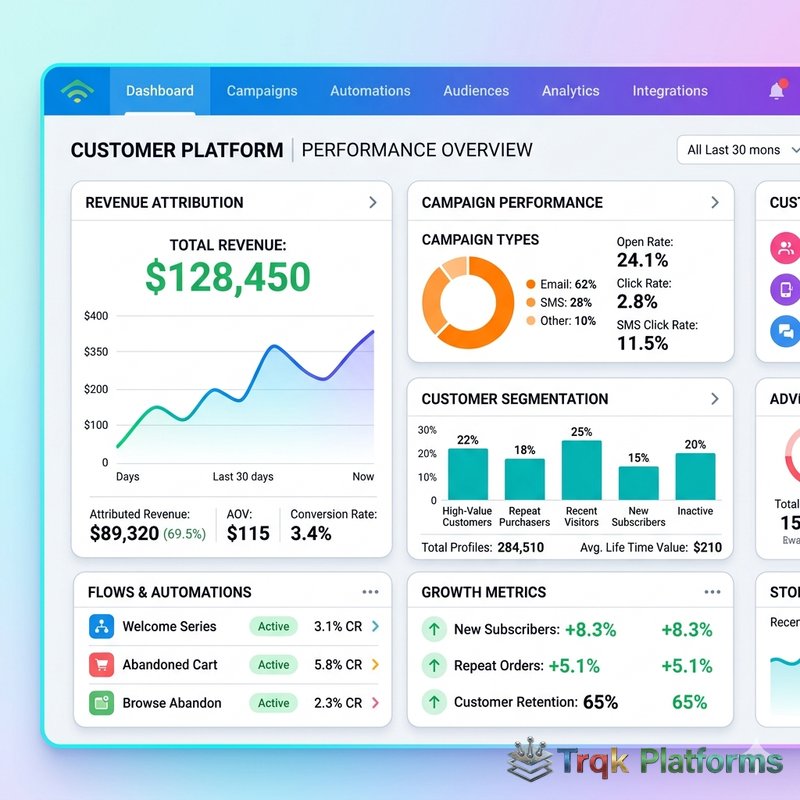
Klaviyo provides comprehensive analytics with a strong focus on revenue attributionâÂÂdirectly connecting email and SMS
campaigns to revenue generated. Key metrics include revenue per recipient (attributed revenue divided by recipients
for each campaign or flow), conversion rates at each stage of automated flows, customer lifetime value trends across
segments, channel performance comparison (email vs. SMS), product performance showing which items drive the most
email-attributed revenue, and A/B test results with statistical significance indicators. The platform’s revenue
attribution model tracks conversions within a configurable attribution window (default 5 days for email, 24 hours
for SMS), connecting specific campaigns and flows to orders placed after the communication.
VII. Pricing Structure
| Plan | Price (for 1,000
contacts) |
Features |
|---|---|---|
| Free | $0/month | Up to 250 contacts, 500 email sends, limited flows |
| $30/month | Full email features, A/B testing, all automations | |
| Email + SMS | $45/month | Email + SMS/MMS marketing, multi-channel flows |
Klaviyo’s pricing scales based on the number of active profiles (contacts with email addresses or phone numbers) in
the account. Costs increase as the contact list growsâÂÂfor example, 5,000 contacts costs approximately $100/month for
the Email plan, 10,000 contacts approximately $150/month, and 50,000 contacts approximately $720/month. SMS
messaging is billed based on SMS/MMS credits consumed, with costs varying by country. While Klaviyo is more
expensive than general-purpose email tools like Mailchimp at comparable list sizes, its e-commerce-specific features
and revenue attribution capabilities often justify the premium for businesses where email drives significant
revenue.
Pricing accurate as of early 2026 â verify current rates on the official Klaviyo website.
VIII. Predictive Analytics
AI-Powered Customer Insights
Klaviyo’s predictive analytics use machine learning models trained on each merchant’s historical data to forecast
individual customer behavior. Predictive features include predicted next order date (estimating when each customer
is likely to purchase again based on their order history patterns), predicted customer lifetime value (forecasting
the total revenue a customer is expected to generate over their relationship with the brand), churn risk prediction
(identifying customers who are likely to stop purchasing), and predicted gender based on name and purchase pattern
analysis. These predictions enable proactive marketingâÂÂtargeting customers with replenishment reminders before they
run out of product, increasing retention efforts for high-value customers showing signs of disengagement, and
focusing acquisition resources on customer profiles that match high-CLV patterns.
Signup Forms and List Building
Klaviyo provides built-in tools for growing email and SMS subscriber lists through customizable signup forms. Form types include embedded forms placed within website pages, pop-up forms triggered by time delay, scroll depth, or exit intent, flyout forms that slide in from the side of the page, and full-page forms for maximum visibility. Each form can be targeted to specific audiencesÂshowing different offers to new visitors versus returning customers, desktop versus mobile users, or visitors from specific traffic sources. Forms integrate directly with Klaviyo’s segmentation, automatically tagging subscribers based on the form they used to sign up, the page they were viewing, and any information they provided. A/B testing for signup forms enables optimization of copy, design, timing, and incentive offers to maximize conversion rates.
Integration Ecosystem
Beyond core e-commerce platform integrations, Klaviyo connects with over 350 third-party tools and platforms. Key integrations include customer review platforms (Yotpo, Stamped, Judge.me) for incorporating review requests into post-purchase flows, loyalty programs (Smile.io, LoyaltyLion) for triggering emails based on loyalty tier changes and point balances, subscription management (Recharge, Bold Subscriptions) for subscription-specific automation, helpdesk platforms (Gorgias, Zendesk) for incorporating support data into customer profiles, Facebook and Google advertising for syncing segments as custom audiences for retargeting and lookalike audience creation, and analytics tools for enhanced reporting and attribution modeling. This broad integration ecosystem enables Klaviyo to serve as the central marketing hub for e-commerce businesses, incorporating data from across the technology stack into unified customer profiles and automated marketing workflows.
Deliverability and Compliance
Email deliverabilityÂthe percentage of emails that reach the recipient’s inbox rather than being filtered to spam folders or bouncedÂis critical for ecommerce communication effectiveness. Klaviyo invests in deliverability infrastructure including dedicated IP addresses for high-volume senders, domain authentication support (SPF, DKIM, DMARC), automated list hygiene that identifies and suppresses unengaged contacts, real-time bounce and complaint monitoring, and compliance tools for CAN-SPAM, GDPR, CCPA, and other privacy regulations. The platform automatically handles unsubscribe processing, suppression list management, and consent tracking to ensure compliance with international ecommerce communication regulations. For merchants operating in the European Union, Klaviyo provides GDPR-compliant consent collection forms, data processing agreements, and tools for managing data subject access requests.
A/B Testing and Optimization
Klaviyo supports comprehensive A/B testing for both campaigns and automated flows. Campaign A/B tests can vary subject lines, preview text, sender names, email content, and send times, with the winning variant automatically sent to the remaining audience after a specified test period. Flow A/B tests enable testing different email content, timing, and offers within automated sequences to continuously optimize performance. The platform provides statistical significance indicators to ensure test results are reliable before declaring winners. Smart send time optimization analyzes each recipient’s historical engagement patterns and delivers emails at the time when each individual is most likely to open and engage, maximizing open rates across the entire subscriber base.
Reviews and Social Proof Integration
Klaviyo integrates with major customer review platforms to incorporate social proof into ecommerce communication strategies. Post-purchase review request flows can be configured to send review solicitation emails at optimal timing based on estimated product delivery and usage time. Review content can be dynamically inserted into product recommendation emails, abandoned cart recovery messages, and browse abandonment emails, leveraging social proof to increase click-through and conversion rates. For merchants using Klaviyo Reviews (Klaviyo’s own review collection feature), the integration is particularly seamless, with review data flowing directly into customer profiles for enhanced segmentation and personalization.
IX. Strengths and Limitations
Strengths
- Purpose-built for e-commerce with deep platform integrations
- Advanced segmentation using purchase, browse, and engagement data
- Powerful automated flow builder with conditional branching
- Integrated SMS marketing on the same platform
- Revenue attribution connecting campaigns directly to sales
- Predictive analytics for CLV, churn risk, and next order date
- Dynamic product recommendations in email content
- Free plan available for small businesses just starting out
Limitations
- Higher pricing than general-purpose ecommerce communication tools
- Costs scale significantly as contact lists grow
- Learning curve for advanced segmentation and flow building
- Best features require Shopify integration (other platforms less supported)
- Template design options less extensive than some competitors
- SMS pricing can add significant cost for high-volume texting
- Not ideal for non-e-commerce businesses due to specialized focus
X. Alternatives to Consider
The e-commerce communication space includes several alternatives worth evaluating. Mailchimp offers a more
affordable general-purpose email platform with basic e-commerce features suitable for businesses with simpler needs.
Omnisend provides similar e-commerce-focused email and SMS marketing with competitive pricing for small to mid-size
stores. Drip focuses on e-commerce CRM with ecommerce communication capabilities. ActiveCampaign combines ecommerce communication
with CRM and sales automation for businesses that need both marketing and sales tools. Postscript specializes
exclusively in SMS marketing for Shopify stores. Attentive focuses on SMS and email with strong enterprise features.
The right choice depends on list size, budget constraints, technical sophistication, and whether e-commerce-specific
features like deep segmentation and revenue attribution justify the premium pricing of specialized platforms like
Klaviyo.
XI. Conclusion
Klaviyo has established itself as the leading customer data and marketing platform purpose-built for e-commerce
businesses that want to move beyond generic email blasts to data-driven, personalized marketing communications. Its
combination of deep e-commerce platform integration, advanced segmentation, sophisticated automation, and revenue
attribution analytics provides the tools needed to transform email from a cost center into a significant revenue
driver. The platform is most valuable for Shopify-based businesses with growing email lists, merchants who want to
leverage customer data for personalized marketing, businesses ready to invest in marketing automation for increased
customer lifetime value, and stores where email and SMS represent important revenue channels worth optimizing.
For e-commerce businesses serious about maximizing the revenue potential of their customer relationships through
personalized, automated marketing communications, Klaviyo’s specialized capabilities represent a meaningful upgrade
over general-purpose ecommerce communication tools.
About The Publisher

TRQK Platforms Editor
The TRQK Editorial Team meticulously investigates and evaluates the world's most powerful digital platforms. Our mission is to provide transparent, in-depth reviews that empower businesses to scale with the right technology.