Etsy occupies a unique position in the e-commerce landscape as a global marketplace specifically focused on handmade
goods, vintage items, craft supplies, and unique products created by independent sellers. Unlike general-purpose
e-commerce platforms where merchants build their own standalone stores, Etsy provides a marketplace ecosystem where
millions of buyers come specifically looking for unique, artisanal, and personalized products that they cannot find
on mainstream retail platforms like Amazon. For creators, artisans, vintage collectors, and small-batch
manufacturers, Etsy provides access to a massive built-in audience of buyers who value craftsmanship, uniqueness,
and the story behind the products they purchase.
Founded in 2005 in Brooklyn, New York, Etsy has grown into a publicly traded company with over 90 million active
buyers and approximately 7.5 million active sellers worldwide. The platform generated over $13 billion in gross
merchandise sales in recent years, demonstrating the scale of the market for unique and handmade products. Etsy’s
success has spawned an entire ecosystem of seller tools, education resources, and third-party services designed to
help sellers optimize their shops and grow their businesses within the marketplace.
This article provides a comprehensive guide to Etsy’s seller tools, marketplace features, fee structure, SEO
optimization, advertising options, and best practices for building a successful Etsy shop. The goal is to present
detailed, practical information for both prospective and current Etsy sellers looking to maximize their marketplace
presence.
I. Setting Up an Etsy Shop
Shop Creation and Configuration
Creating an Etsy shop is straightforward and can be completed within an hour. The setup process includes selecting a
shop name (unique across the Etsy marketplace), configuring currency and language preferences, setting up payment
processing through Etsy Payments (which handles credit cards, debit cards, PayPal, Apple Pay, Google Pay, and
various localized payment methods), defining shipping profiles with rates and processing times, and establishing
shop policies for returns, exchanges, and custom orders. Etsy charges no monthly subscription fee for a basic
shop—sellers pay only listing fees and transaction fees on sales, making it one of the lowest-barrier entry points
for selling products online.
Shop Branding
Etsy provides customization options for shop branding including a shop banner image, shop icon/logo, about section
with the seller’s story and photos, featured listings displayed prominently in the shop, and shop announcement text
visible to all visitors. While Etsy shops exist within the Etsy marketplace framework (limiting design customization
compared to standalone e-commerce stores), the branding tools enable sellers to establish a recognizable identity
that differentiates their shop from competitors within the marketplace.
II. Product Listing and Optimization
Listing Structure
| Listing Element | Details | SEO Impact |
|---|---|---|
| Title | Up to 140 characters | Primary ranking factor for Etsy search |
| Photos | Up to 10 images per listing | First image critical for click-through rate |
| Video | One video per listing (5-15 seconds) | Improves engagement and conversion |
| Tags | Up to 13 tags per listing | Major ranking factor, use all 13 |
| Description | Unlimited length | Indexed by Google, moderate Etsy impact |
| Categories | Main category + subcategories | Determines browse placement |
| Attributes | Color, size, material, occasion, etc. | Enables filtered search results |
Etsy SEO Best Practices
Etsy search is the primary discovery mechanism for products within the marketplace, and optimizing listings for
Etsy’s search algorithm is essential for visibility. Key SEO practices include placing the most important keywords
at the beginning of the title (Etsy’s algorithm weights the first words most heavily), using all 13 available tags
with diverse, descriptive phrases that potential buyers might search for, filling in all available attributes and
category fields to appear in filtered search results, using long-tail keyword phrases that match specific buyer
search intent rather than overly broad terms, and regularly renewing or updating listings to signal freshness to the
algorithm. Etsy’s search algorithm considers relevance (keyword match between the search query and listing details),
listing quality (based on click-through rate, favorites, and conversion rate), and recency (recently listed or
renewed items may receive a temporary visibility boost).
III. Fee Structure
| Fee Type | Amount | When Applied |
|---|---|---|
| Listing Fee | $0.20 per listing | When listing is created or renewed (every 4 months) |
| Transaction Fee | 6.5% of total sale price | On every sale (includes shipping cost) |
| Payment Processing | 3% + $0.25 per transaction | Etsy Payments processing fee |
| Offsite Ads Fee | 12-15% of sale amount | Only on sales from Etsy’s offsite ads (mandatory for some) |
| Etsy Plus (optional) | $10/month | Monthly subscription for advanced shop features |
The combined effect of listing fees, transaction fees, and payment processing means that Etsy takes approximately
10-12% of each sale’s total value before advertising costs. When offsite ads fees apply (mandatory for shops with
over $10,000 in trailing 12-month revenue), the total percentage can reach 22-27% on ad-attributed sales. Sellers
must factor these fees into their pricing strategy to maintain healthy profit margins.
IV. Etsy Advertising
Etsy Ads
Etsy Ads is the platform’s internal advertising system that promotes listings within Etsy search results and on
listing pages. Sellers set a daily budget (minimum $1/day), and Etsy distributes the budget across listings based on
the platform’s assessment of which listings are most likely to generate clicks and sales. Etsy Ads operates on a
cost-per-click (CPC) model, with actual CPC varying based on competition, category, and listing quality. Sellers can
select which listings to advertise and monitor performance through metrics including impressions, clicks,
click-through rate, orders attributed to ads, revenue generated, and return on ad spend (ROAS).
Offsite Ads
Etsy’s Offsite Ads program promotes sellers’ listings on external platforms including Google, Facebook, Instagram,
Pinterest, and Bing. Unlike Etsy Ads, sellers do not pay for clicks—instead, a fee is charged only when a sale
results from an offsite ad click (12% for shops with over $10,000 annual revenue, 15% for smaller shops). Shops
generating over $10,000 in trailing 12-month revenue cannot opt out of the Offsite Ads program, which has been a
point of contention among some sellers who feel the mandatory nature of the program and its 12% fee erodes their
margins on sales they might have received organically.
V. Seller Tools and Analytics
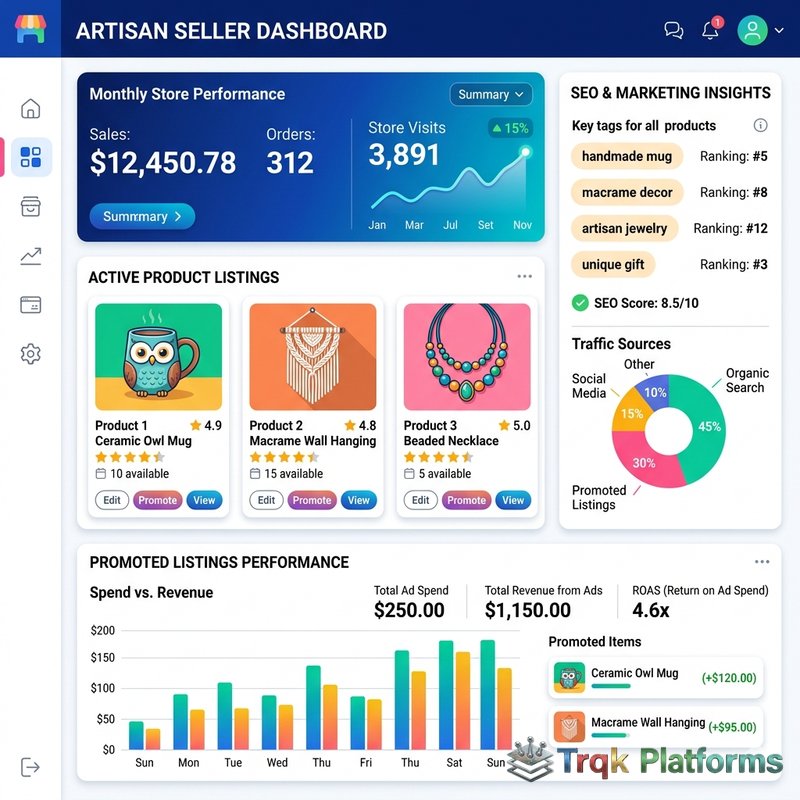
Shop Manager Dashboard
The Shop Manager is the central hub for managing an Etsy shop, providing access to order management and fulfillment,
listing creation and editing, shop settings and policies, financial statements and payment history, customer
messages and conversations, and marketing and advertising controls. The dashboard provides at-a-glance metrics
including daily views, visits, orders, and revenue, with the ability to drill into detailed reports for deeper
analysis.
Etsy Stats and Analytics
Etsy provides built-in analytics covering traffic sources (showing where visitors come from—Etsy search, direct
traffic, social media, external search engines), listing performance (views, favorites, and conversion rate for each
listing), search terms (showing which keywords buyers used to find listings), revenue by day, week, and month with
trend visualization, and geographic data showing where buyers are located. These analytics help sellers understand
which listings perform best, which traffic sources drive the most sales, and how seasonal trends affect their
business.
Customer Communication
Etsy’s messaging system enables direct communication between sellers and buyers for pre-purchase questions, custom order requests, order updates, and post-purchase support. Sellers can create saved replies for frequently asked questions, reducing response time for common inquiries. Etsy tracks seller response time and rate, and shops that maintain fast response times may receive a “Star Seller” badge that signals reliability to potential buyers. The messaging system also supports file attachments, enabling sellers to share mockups, proofs, and customization options with buyers before production.
Etsy Plus Subscription
Etsy Plus is an optional monthly subscription at ten dollars per month that provides additional shop customization options and marketing tools. Features included in Etsy Plus are shop banner templates and advanced customization options, restock request alerts that notify interested buyers when out-of-stock items become available again, fifteen listing credits per month (offsetting the listing fee cost), a five dollar monthly credit for Etsy Ads, advanced shop analytics with additional data points, and custom web address options for the shop page. For established sellers with consistent sales volume, the listing credits and advertising credit can offset a significant portion of the subscription cost.
Star Seller Program
Etsy’s Star Seller program recognizes shops that consistently meet high performance standards across three metrics: message response rate (responding to initial messages within 24 hours for 95% or more of messages), on-time shipping and tracking (shipping orders on time with tracking for 95% or more of orders), and review ratings (maintaining a 4.8-star or higher average rating over the trailing period). Shops that meet all three criteria receive a Star Seller badge displayed on listings and the shop page, which can increase buyer confidence and click-through rates. While the Star Seller program is not a direct ranking factor in Etsy search, the badge serves as a trust signal that can influence conversion rates.
Shipping and Fulfillment Tools
Etsy provides built-in shipping tools including Etsy Shipping Labels with discounted USPS, UPS, FedEx, and Canada Post rates (savings can reach up to 30% compared to retail carrier rates), calculated shipping that automatically determines shipping cost based on package dimensions, weight, and destination, shipping profiles that allow sellers to define shipping costs and processing times for groups of similar products, and international shipping settings with customs declaration support. Etsy also provides estimated delivery dates on listings, which factor in the seller’s stated processing time and the carrier’s transit time for the buyer’s location. Sellers who offer free shipping on orders over may receive a search ranking boost, as Etsy has encouraged free shipping policies to improve buyer experience.
Print on Demand and Production Partners
Etsy allows sellers to work with production partners who handle manufacturing while the seller provides the designs, manages the shop, and handles customer relationships. This model is commonly used for print-on-demand products where the seller creates designs and a production partner prints them on merchandise (t-shirts, mugs, phone cases, etc.) and ships them directly to buyers. Sellers using production partners must disclose this relationship in their listings, maintaining Etsy’s transparency standards. Popular production partners for Etsy sellers include Printful, Printify, and Gooten, which integrate directly with Etsy to automate order fulfillment.
VI. Strengths and Limitations
Strengths
- Access to 90+ million active buyers specifically seeking unique products
- No monthly subscription fee for basic shops
- Low startup cost—only $0.20 per listing to get started
- Built-in search traffic eliminates need for separate SEO and advertising
- Strong community and brand trust among handmade/vintage buyers
- Integrated payment processing with multiple payment methods
- Seller protection policies for eligible transactions
- Mobile app for shop management on the go
Limitations
- Combined fees of 10-12% reduce profit margins significantly
- Mandatory Offsite Ads for shops over $10K annual revenue
- Limited shop customization compared to standalone e-commerce stores
- Intense competition within popular product categories
- Dependent on Etsy’s algorithm for search visibility
- Etsy owns the customer relationship, limiting direct marketing
- Policy changes can significantly impact seller businesses
- Increasing presence of resellers challenges the handmade marketplace identity
Whether selling handmade jewelry, vintage clothing, digital downloads, or custom artwork, Etsy provides the marketplace infrastructure, payment processing, and built-in buyer traffic that enable creative entrepreneurs to transform their passion into a viable online business without the technical complexity of building and marketing a standalone e-commerce store.
VII. Conclusion
Etsy provides an unmatched marketplace for creators, artisans, and small-batch manufacturers to reach a massive
audience of buyers who specifically value unique, handmade, and vintage products. The platform’s built-in traffic
and brand trust eliminate the need for new sellers to build an audience from scratch—a significant advantage over
standalone e-commerce stores where attracting visitors requires separate marketing investment. For sellers of
handmade goods, personalized products, vintage items, and craft supplies, Etsy remains the most relevant and
effective marketplace for reaching their target customers.
However, the marketplace model comes with trade-offs: higher combined fees compared to standalone e-commerce
platforms, limited control over shop design and customer relationships, and dependency on Etsy’s search algorithm
and policy decisions. Many successful Etsy sellers eventually diversify by launching their own website (using
Shopify, Squarespace, or similar platforms) alongside their Etsy shop, using Etsy as a customer acquisition channel
while building a direct-to-consumer brand that provides more control, higher margins, and a direct customer
relationship for long-term business sustainability.
About The Publisher

TRQK Platforms Editor
The TRQK Editorial Team meticulously investigates and evaluates the world's most powerful digital platforms. Our mission is to provide transparent, in-depth reviews that empower businesses to scale with the right technology.