The e-commerce platform market is often framed as a two-way competition between Shopify and WooCommerce, but several
other platforms serve specific market segments with compelling feature sets. BigCommerce occupies a distinctive
position in this landscape as an enterprise-grade SaaS e-commerce platform that combines the convenience of hosted
solutions with the flexibility and feature depth typically associated with custom-built or open-source platforms.
For mid-market and enterprise businesses that need advanced built-in functionality without the technical overhead of
self-hosted solutions, BigCommerce offers a compelling alternative to both Shopify and WooCommerce.
Founded in 2009 by Eddie Machaalani and Mitchell Harper in Sydney, Australia, BigCommerce has grown into a publicly
traded company powering thousands of online stores across more than 150 countries. Notable brands using BigCommerce
include Ben & Jerry’s, Skullcandy, Sony, and Woolrich. The platform differentiates itself through its extensive
built-in feature set—many features that require paid apps or plugins on competing platforms are included natively in
BigCommerce at no additional cost—and its “open SaaS” philosophy that combines managed hosting with API-driven
flexibility and headless commerce capabilities.
This article provides a detailed examination of BigCommerce’s features, pricing, B2B capabilities, multi-channel
selling tools, SEO capabilities, strengths, and limitations. The goal is to present comprehensive, objective
information that helps you evaluate whether BigCommerce aligns with your e-commerce business requirements.
I. Platform Architecture and Approach
Open SaaS Philosophy
BigCommerce describes its approach as “Open SaaS”—combining the operational benefits of Software-as-a-Service (hosted
infrastructure, automatic updates, managed security) with the flexibility of open, API-driven architecture. Unlike
traditional SaaS platforms that can feel restrictive, BigCommerce provides extensive API coverage that allows
merchants and developers to customize, extend, and integrate the platform with virtually any third-party system.
This approach enables headless commerce implementations where BigCommerce serves as the backend commerce engine
while a separate frontend framework (React, Next.js, Gatsby, or other modern frameworks) handles the customer-facing
storefront experience.
Headless Commerce Capabilities
BigCommerce’s headless commerce support is one of its strongest technical differentiators. The platform’s
comprehensive APIs—including Catalog, Cart, Checkout, Orders, Customers, and Storefront APIs—enable developers to
build completely custom frontend experiences while leveraging BigCommerce’s proven commerce backend for product
management, order processing, payment handling, and inventory tracking. BigCommerce provides pre-built integrations
with popular frontend frameworks and content management systems including Next.js, Gatsby, WordPress, Contentful,
and Bloomreach, making it easier to implement headless architecture without building everything from scratch.
II. Built-In Features
Feature-Rich Out of the Box
One of BigCommerce’s most significant advantages is the breadth of features included in every plan without requiring
additional paid apps:
| Feature Category | Built-In Capabilities |
|---|---|
| Product Management | Unlimited product variants (up to 600 SKUs), bulk pricing, custom fields |
| Payment Processing | 65+ payment gateways with zero transaction fees on all plans |
| Shipping | Real-time carrier quotes, shipping rules, free shipping thresholds |
| SEO | Customizable URLs, auto-generated sitemaps, 301 redirects, microdata |
| Multi-Channel | Amazon, eBay, Facebook, Instagram, Google Shopping, |
| B2B Features | Customer groups, price lists, purchase orders, quote management |
| Discounts & Promotions | Coupon codes, automatic discounts, BOGO, cart-level promotions |
This built-in feature depth means that BigCommerce merchants often need fewer third-party apps than Shopify
merchants, which can result in lower total cost of ownership despite similar base subscription prices. Features like
real-time shipping quotes, advanced product filtering (faceted search), customer group pricing, and multi-currency
support that require paid apps on other platforms are included natively in BigCommerce.
III. B2B E-commerce Capabilities
Business-to-Business Features
BigCommerce has invested heavily in B2B e-commerce capabilities, making it one of the few SaaS platforms that can
serve both B2C and B2B selling scenarios effectively. Key B2B features include Customer Groups that allow different
pricing, payment methods, and catalog visibility for different customer segments (wholesale, retail, VIP, etc.),
Price Lists that enable per-customer or per-group pricing with volume discounts and tiered pricing structures, Quote
Management for handling complex B2B purchasing workflows where prices are negotiated, Purchase Orders that allow
approved business accounts to buy on credit terms, Company Accounts with multiple user roles and approval workflows
within a single business account, and Restricted Content that can hide or display products, categories, and pages
based on customer group membership.
B2B Edition
BigCommerce B2B Edition is a purpose-built solution that adds advanced B2B functionality including buyer portals,
corporate account hierarchies, requisition lists, role-based permissions, budget management, and sophisticated
pricing rules. This edition is designed for manufacturers, distributors, and wholesalers who need enterprise-grade
B2B capabilities without building a custom platform. The combination of B2C simplicity with B2B depth makes
BigCommerce particularly attractive for businesses that serve both consumer and business customers through a single
platform.
IV. Multi-Channel Selling
Channel Manager
BigCommerce’s Channel Manager provides centralized control over product listings, inventory, and orders across
multiple sales channels. Built-in channel integrations include Amazon (synced product listings and order
management), eBay (automated listing creation and inventory sync), Facebook and Instagram Shops (social selling with
integrated checkout), Google Shopping (product feed management and advertising), Pinterest (buyable pins), and
Walmart Marketplace. The Channel Manager synchronizes inventory levels across all channels, preventing overselling
and maintaining consistent product information regardless of where a customer discovers and purchases a product.
V. Pricing Structure
| Plan | Monthly Price | Sales Limit | Key Features |
|---|---|---|---|
| Standard | $39/month | Up to $50K/year | All core features, unlimited products, staff accounts |
| Plus | $105/month | Up to $180K/year | + Customer groups, segmentation, abandoned cart saver |
| Pro | $399/month | Up to $400K/year | + Google customer reviews, faceted search, price lists |
| Enterprise | Custom pricing | Unlimited | + Custom SSL, API priority, dedicated account manager |
A notable aspect of BigCommerce’s pricing is the annual sales thresholds for each plan. When a store’s revenue
exceeds the threshold for their current plan, they are required to upgrade to the next tier. This revenue-based
pricing model means that growing businesses need to factor in plan upgrades as their sales increase. However,
BigCommerce charges zero transaction fees on all plans regardless of which payment gateway is used—a significant
advantage over Shopify, which charges 0.5-2% on transactions processed through third-party gateways.
Pricing accurate as of early 2026 — verify current rates on the official BigCommerce website.
Order Management and Fulfillment
BigCommerce provides a comprehensive order management system that handles the entire lifecycle from order placement through fulfillment and delivery. The Orders dashboard displays all orders across channels with filtering by status, date, customer, and channel. Order processing features include bulk order updates, automatic order status notifications to customers via email, manual order creation for phone or offline orders, refund and return processing with restocking options, and order editing capabilities for modifying items, quantities, and shipping details before fulfillment. For businesses with complex fulfillment needs, BigCommerce integrates with third-party fulfillment services and warehouse management systems, enabling automated routing of orders to the appropriate fulfillment center based on product availability, customer location, and shipping method selection.
Payment Gateway Flexibility
BigCommerce supports over 65 payment gateways worldwide, including major providers like PayPal, Stripe, Square, Authorize.net, Braintree, Adyen, and dozens of region-specific payment processors. A key differentiator is that BigCommerce charges zero platform transaction fees regardless of which payment gateway merchants choose to use. This stands in contrast to Shopify, which charges 0.5% to 2% on transactions processed through third-party gateways (non-Shopify Payments). For businesses processing significant transaction volumes through preferred payment providers, this zero-fee policy can result in substantial annual savings. BigCommerce also supports digital wallets including Apple Pay, Google Pay, and Amazon Pay, as well as buy-now-pay-later services like Klarna, Afterpay, and PayPal Pay Later, providing customers with flexible payment options that can increase conversion rates and average order values.
Customer Management
The platform includes built-in customer management tools that go beyond basic account creation. Customer profiles store purchase history, contact information, addresses, and custom field data. Customer Groups enable different pricing, product visibility, payment methods, and shipping options for different customer segments-a feature particularly important for businesses serving both wholesale and retail customers. BigCommerce automatically tracks customer data including total spend, order frequency, and account creation date, which can be used for segmentation and targeted marketing through integrated email marketing tools. The Storefront Customers API allows headless implementations to leverage BigCommerce’s customer management capabilities within custom frontend experiences.
VI. SEO and Performance
Built-In SEO Tools
Analytics and Reporting
BigCommerce includes a comprehensive analytics dashboard with built-in reports covering sales performance, customer acquisition and retention metrics, abandoned cart data, marketing channel performance, and product-level analytics. The Ecommerce Analytics section provides real-time sales data, conversion rate tracking, average order value trends, and customer lifetime value calculations. BigCommerce also integrates with Google Analytics (including GA4) and supports enhanced e-commerce tracking, providing detailed funnel analysis from product view through checkout completion. For businesses requiring custom analytics, BigCommerce’s data can be exported or accessed via API for integration with business intelligence platforms like Tableau, Power BI, or Looker.
Store Design and Themes
BigCommerce uses a theme framework called Stencil that provides responsive, mobile-optimized storefront designs. The BigCommerce Theme Marketplace offers both free and premium themes designed specifically for BigCommerce, with prices for premium themes typically ranging from to . Stencil themes support YAML-based configuration for no-code customization and Handlebars templating for developer-level modifications. The Page Builder tool enables visual, drag-and-drop page construction without code, allowing merchants to create custom landing pages, promotional pages, and content sections within their storefront. For businesses using headless commerce, the frontend design is entirely independent of BigCommerce’s theme system, as the storefront is built using the merchant’s chosen frontend framework.
Security and Compliance
As a hosted SaaS platform, BigCommerce handles all aspects of infrastructure security including PCI DSS Level 1 compliance (the highest level of payment card security certification), SSL certificate management, DDoS protection, and automatic security patching. The platform maintains 99.99% uptime SLA (Service Level Agreement) guarantees, providing reliability assurance for businesses that cannot afford storefront downtime. BigCommerce stores benefit from the platform’s CDN (Content Delivery Network) infrastructure, which distributes storefront content across global data centers for fast loading times regardless of customer location. The platform also supports two-factor authentication for admin access, IP-based access restrictions for the control panel, and detailed audit logs for tracking administrative changes.
International Selling
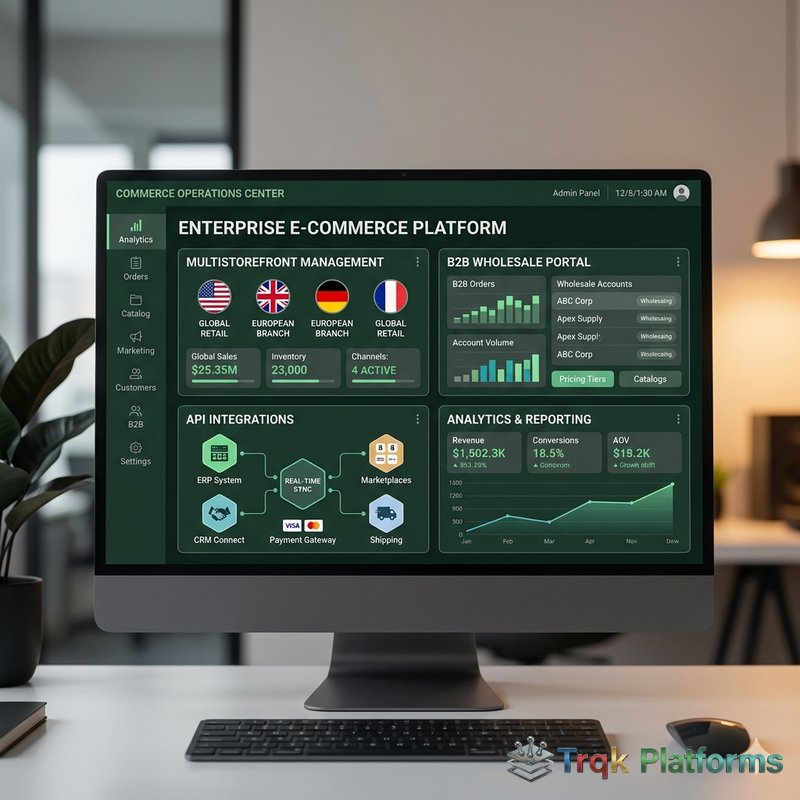
BigCommerce provides built-in multi-currency support that allows merchants to display prices and accept payments in multiple currencies without requiring third-party apps. The platform supports automatic currency conversion based on real-time exchange rates, fixed pricing in specific currencies for markets where the merchant wants full control over regional pricing, and geolocation-based currency switching that automatically shows prices in the customer’s local currency. For multi-language requirements, BigCommerce integrates with translation services and supports multiple storefronts through its MSF (Multi-Storefront) feature, which allows merchants to operate separate branded storefronts with different designs, product catalogs, and pricing from a single BigCommerce backend. This multi-storefront capability is particularly valuable for businesses operating across multiple regions, brands, or market segments.
App Ecosystem and Integrations
While BigCommerce’s built-in feature set is more comprehensive than many competitors, the platform also offers an app marketplace with hundreds of third-party integrations covering categories including marketing and advertising, shipping and fulfillment, accounting and finance, inventory management, customer service, loyalty programs, and product reviews. Key integrations include connections with major ERP systems (NetSuite, Sage, Microsoft Dynamics), CRM platforms (Salesforce, HubSpot), marketing automation tools (Mailchimp, Klaviyo, Omnisend), and shipping platforms (ShipStation, ShipBob, EasyPost). BigCommerce’s open API architecture also enables custom integrations with proprietary business systems that are not covered by existing marketplace apps.
VII. Strengths and Limitations
Strengths
- Extensive built-in features reduce dependency on paid apps
- Zero transaction fees on all plans, any payment gateway
- Strong B2B capabilities including customer groups and price lists
- Open SaaS architecture with comprehensive API coverage
- Headless commerce support for custom frontend experiences
- Flexible URL structures for superior SEO control
- Multi-channel selling with centralized inventory management
- Unlimited products, file storage, and staff accounts on all plans
Limitations
- Annual sales thresholds force plan upgrades as revenue grows
- Fewer free themes compared to Shopify’s theme store
- Smaller app ecosystem than Shopify or WooCommerce
- Steeper learning curve due to feature density
- Higher starting price point for the Pro plan with advanced features
- Less brand recognition than Shopify in the SMB market
- Limited built-in blogging compared to WordPress/WooCommerce
Support and Resources
BigCommerce provides 24/7 customer support through phone, live chat, and email for all plan levels. The support team is knowledgeable about e-commerce operations and can assist with platform configuration, troubleshooting, and best practices guidance. Additionally, BigCommerce offers an extensive knowledge base with documentation, video tutorials, and community forums. For Enterprise plan customers, dedicated account managers provide strategic guidance and priority support. The BigCommerce Community forum connects merchants with other store owners and BigCommerce experts for peer advice and solution sharing. BigCommerce also hosts an annual partner summit and user conference for networking and education, and provides a BigCommerce University learning platform with structured courses on store setup, marketing, and growth strategies.
The platform’s developer community is supported by comprehensive API documentation, SDKs for multiple programming languages, and a developer portal with sandbox environments for testing integrations. BigCommerce’s partner ecosystem includes certified agency partners who specialize in BigCommerce implementations, providing professional services for custom development, migration, and ongoing store optimization.
VIII. Alternatives to Consider
For businesses evaluating enterprise-grade e-commerce platforms, several alternatives are worth considering. Shopify
Plus provides enterprise features within Shopify’s ecosystem with a starting price around $2,000 per month. Adobe
Commerce (formerly Magento) offers extensive customization for businesses with developer resources for a
self-hosted, open-source enterprise solution. Salesforce Commerce Cloud integrates deeply with the Salesforce CRM
ecosystem for unified customer data. commercetools and Elastic Path provide API-first, headless commerce platforms
for businesses building fully custom frontends. WooCommerce on managed WordPress hosting can serve mid-market
businesses that prefer open-source flexibility with lower platform costs. Each alternative involves different
trade-offs between cost, control, features, and technical requirements.
Whether evaluating BigCommerce for a new e-commerce venture or considering a migration from another platform, the platform’s combination of built-in feature depth, API-driven flexibility, and zero transaction fees makes it a strong contender for businesses that have outgrown entry-level solutions and need enterprise capabilities without enterprise-level complexity or custom development overhead.
IX. Conclusion
BigCommerce occupies a valuable middle ground in the e-commerce platform landscape—more feature-rich and flexible
than standard Shopify plans, yet simpler to manage than self-hosted solutions like WooCommerce or Magento. Its
zero-transaction-fee policy, built-in B2B capabilities, headless commerce support, and extensive native feature set
make it particularly well-suited for growing businesses that need enterprise-grade functionality without
enterprise-level complexity or custom development costs. The platform is most compelling for mid-market businesses
with $500K to $50M in annual revenue, businesses serving both B2C and B2B customers, merchants who want to avoid the
cumulative cost of third-party apps, and businesses planning headless or composable commerce architectures.
For businesses in these categories, BigCommerce provides a robust and scalable foundation that can support growth
without requiring platform migration as the business expands.
About The Publisher

TRQK Platforms Editor
The TRQK Editorial Team meticulously investigates and evaluates the world's most powerful digital platforms. Our mission is to provide transparent, in-depth reviews that empower businesses to scale with the right technology.